Newbery Honor 1929: Whew I am done!

It took me awhile to get through 1929.  Some of these books were great.  Some of them were not.

I could not get into Tod of the Fens and Clearing WeatherTod of the Fens is supposed to be a farcical type story, and I could see where there was humor in it, but I got too bogged down in language and what I thought was not a great pace.  I skimmed it.

I wasn’t crazy about Clearing Weather either.  In a nutshell this book is about building a ship and sailing it to Jamaica.  However there’s nothing remotely “in a nutshell” about this long-winded book.  People of color do not fare well in this book which I guess is not surprising given the time in which it takes place and the time in which it is written. To put it briefly, every page I read in this book just made me tired, and I gave myself permission to put it aside (permanently).

I wrote about The PIgtail of Ah Lee Ben Loo in another post.  The best thing about this book (for me) was the amazing illustrations.  I also wrote about Millions of Cats and The Boy Who Was.  These were both excellent books.

Another book I really liked was Runaway Papoose. This book was just delightful.  Nah-Tee, the main character, is a Native American girl who lives in a pueblo in the Southwest.  I like how Grace Moon writes.  For example, she describes riding through the loneliness of the desert:  “This was a jolly loneliness – it was a sparkly daytime loneliness, and there wasn’t a fear thought hiding away anywhere.  Somehow, there was a smile in everything.” Nah-tee and Moyo are two heroic children who work together to complete their quest.  There is adventure, humor, and great love in this story.  This is one of my favorites so far (I think I say this a lot!).

And finally – the Winner!

The Trumpeter of Krakow, by Eric P. Kelly, is an exciting book that takes place in the 1400s in Krakow Poland.  It’s a very fun mystery and adventure story.  I always love a mystery with a good story behind it.  Alchemy is an important part of the story which was fun too.  I really liked this one.
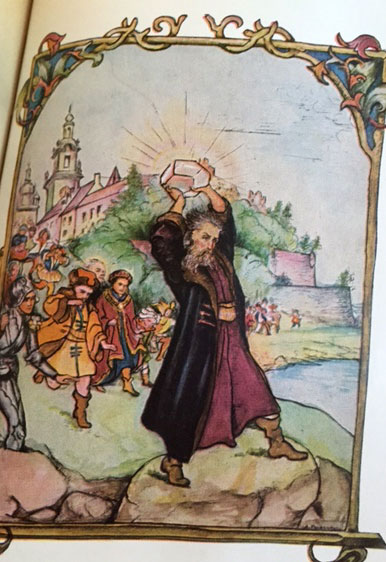
Krakow

I am glad to put 1929 behind me.  I try not to apply my 2016 perspective to the literature of the 1920s, but these books seem inconsistent.  There are some books that I can not imagine a child ever slogging through, and then there are some books that are wonderful and a delight to read.  It will be interesting to see what the 1930s bring!

 

Newbery Honor 1929: Runaway Papoose

This book was just delightful.  Nah-Tee, the main character, is a Native American girl who lives in a pueblo in the Southwest.  She is very brave and she meets an also brave friend named Moyo. Nah-tee has become separated from her family, and this book is about their search to find them.

I like how Grace Moon writes.  For example, Nahtee describes riding through the loneliness of the desert:  “This was a jolly loneliness – it was a sparkly daytime loneliness, and there wasn’t a fear thought hiding away anywhere.  Somehow, there was a smile in everything.”

There is some language in a few places that would be considered insensitive in today’s world.  But Nah-tee and Moyo are portrayed as such heroic children who work together to complete their quest, and overall I believe it’s a positive portrayal of independent Native American children.  This is one of my favorites so far (I think I say this a lot!).

Red Top

Yesterday we went on a hike to Red Top Lookout.   Our goal was to get here:

redtop2

It was about an hour’s drive from our house, but much of the drive was the climb up a winding dirt road to about 5,000 feet.  Once we got there, the hike was not even a mile long, but it was a steep climb up.

Red Top Lookout is a fire watch tower and is apparently staffed by volunteers in the summer.  They weren’t there yet, so I don’t know what the current status is of that.  When we got to the top, it was locked up.

There were wildflowers in abundance on this hike.

redtop5

I also thought this orange moss was pretty cool.

redtop4

This hike goes through a beautiful wooded forest for a little while.


redtop8

Then it went up steeply along a rather slippery rocky slope.

redtop6

There is a cute little outhouse located near the lookout.

redtop9

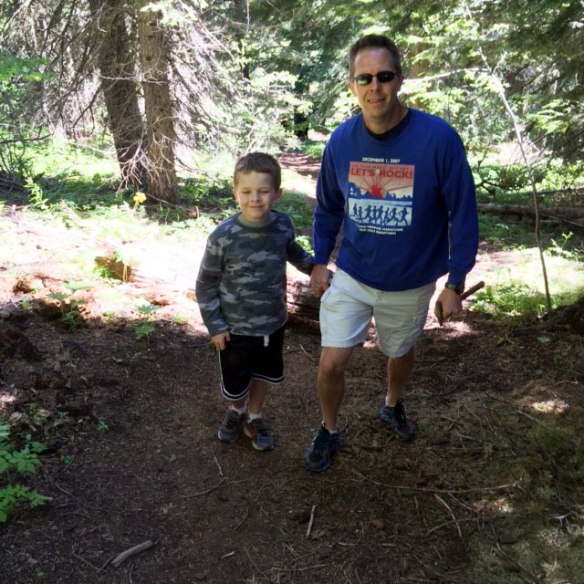
The top is a little scary.  If you are afraid of heights, you might feel a little nervous.  If you are afraid of heights + a slippery steep rock-riddled slope then you might feel more nervous.  This is me B.F. (before fall).

redtop3

Immediately after this, Davey and David started heading down while I was taking a few pictures.  Then I started heading down.  Well I slipped and landed on a sharp rock. Fortunately, I didn’t almost fall off the mountain or anything, but I fell hard. Ow.  I was ok (although today I am a little beat up and also have a bruised gluteus maximus).

After that, I went down very gingerly and slowly (probably too gingerly and slowly), but I made it!  The hike up was worth it for this amazing view.

redtop7

It was a little cloudy.  We had a 360 degree view, and on a really clear day we would have seen Mt. Rainier and I think Mt. Adams.

This was a beautiful, short, fun, steep and slightly terrifying hike!

Newbery Honor 1929: The Boy Who Was

When I started reading The Boy Who Was, I didn’t think that I was going to like it much. First, I saw that it was going to be another book of short stories.  Second, the book began with stories about the Sirens and Odysseus.  I love Greek mythology, but I have read these stories several times now so I wasn’t too excited about more Greek mythology.

So I began the book with the attitude that I was probably going to be doing some skimming.  Instead, I soon realized that the story was actually about a little Italian goat-herder boy named Nino.  He loved to sit by the seashore and listen to the Sirens sing (the songs did not affect him quite like they did the sailors on the ships!).  One day the Sirens became very distraught when Odysseus outsmarted them by putting wax in the ears of his sailors and strapping himself to the ship.  The Siren sisters felt like failures because their songs didn’t end up in Odysseus wrecking his ship so they threw themselves off a cliff.  Before they did so though, one of the sisters gave Nino eternal life.

The rest of the stories take place during different time periods in Italy.  At least a hundred years pass between almost every story.  Nino turns out to be a quiet wonderful hero.  Once I realized what this book was really about, I no longer wanted to skim.  It has turned out to be one of my favorites.  Some of Nino’s adventures include being present at Pompeii (when Mt. Vesuvius erupts!), and he also has an encounter with Redbeard.

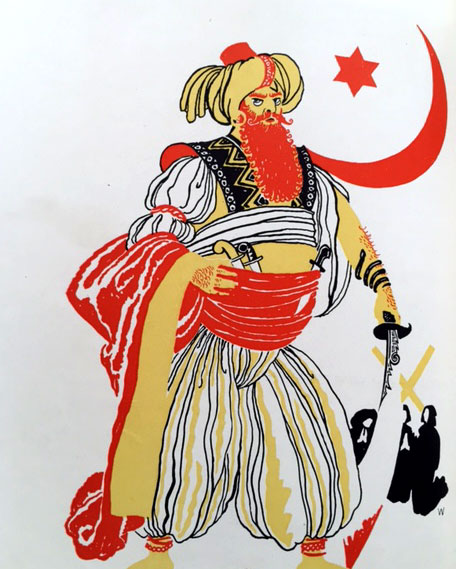
Once again, there are some beautiful illustrations. Here’s Redbeard:

bowywhowas3

In the final story, Nino joins a group of bandits who kidnap a very grumpy unkind Prince.  The Prince is miserably overweight and unhappy.  This tale could have served as inspiration for The Biggest Loser (with the exception of the kidnapping part!). The bandits put the prince on a diet and exercise regime and change his life.  In the end, they part as good friends.  It’s a great story.

Here is the unhappy overweight grumpy prince:

Boywhowas1I am learning that I tend to want to give up on a book too quickly.   Sometimes it takes a little while to appreciate what a real gem a book can be.  This book was definitely a gem.

boywho2


Newbery 1929: The Pigtails of Ah Lee Ben Loo and Millions of Cats

I am making my way through the 1929 Newbery books.  In 1929, six Newbery honor books were chosen plus the Medal winner.

Millions of Cats was the first picture book that I encountered as a Newbery Honor.  This is such a nice story.

millions

It is about a couple who want to adopt a cat, but who end up with literally millions of cats.  The story focuses on how they acquired the cats and then how they were able to end up with only one cat.  It’s a fun story.  I enjoyed the absolute hyperbole of the idea of bringing home that many cats.

In the end, the sweet couple has a wonderful cat addition to their little family.

millions2

I guess that was a spoiler, but it’s an inevitable ending I think!  This is a book I’d love to read with a young class.  The illustrations of the millions of cats and how much they ate and drank would be a lot of fun to share with young children.

The other book I’ve read (kinda) is The Pigtails of Ah Lee Ben Loo.  This book is full of silly almost nursery type rhymes and tales.  I really didn’t get into it all that much and ended up skimming through it.  It might be a good one to read in small chunks before bedtime, but I really didn’t find the stories incredibly engaging.

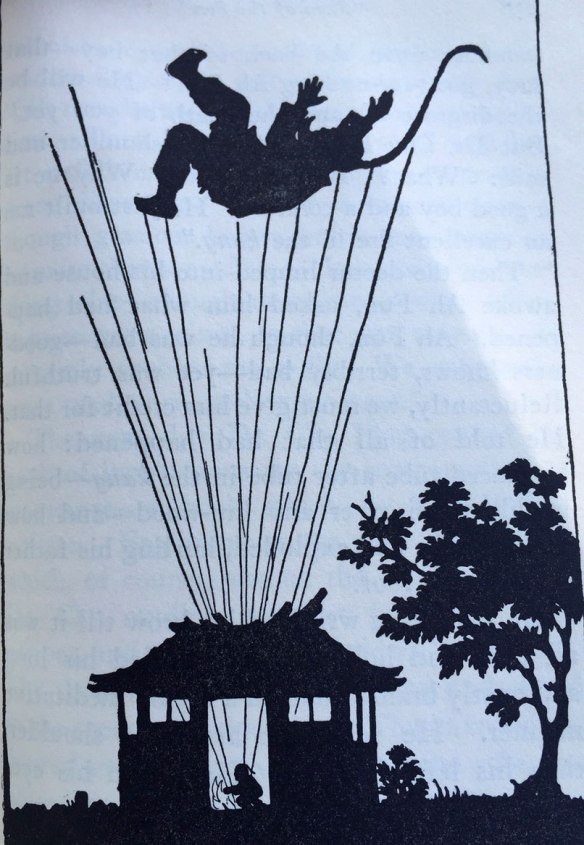
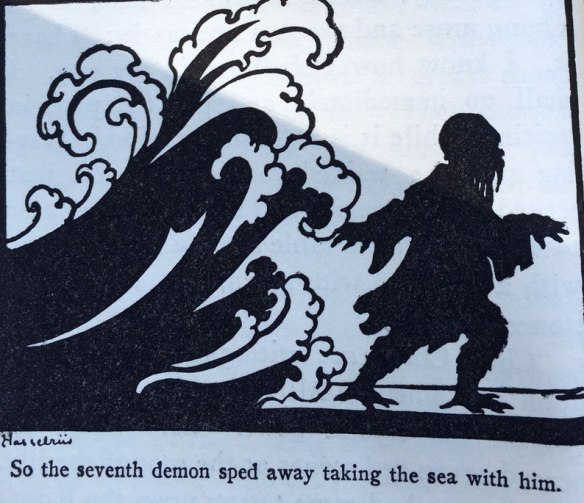
What I did find engaging about the book however, and what made it definitely worth looking at were the silhouette illustrations.

pigtails1

I spent a lot of time looking at the illustrations which were filled with energy and humor.

pigtails2I love the dairymaid in the picture above!

Newbery Honor 1928: The Wonder Smith and Downright Dencey

The two Honor books for 1928 were The Wonder Smith and His Son
by Ella Young and Downright Dencey by Caroline Dale Snedeker.

The Wonder Smith is a book of Irish folklore.  It tells the tales of Gubbaun Saor the legendary smith.  It is told in the style of Celtic lore, and the language can be a little hard to follow at times.  The language is beautiful though, and there is humor and wisdom to be found in the stories.  My favorite parts are the Irish blessings which can be found throughout the story: “May my blessing run before you.  May my blessing guard you on the right hand and on the left.  May my blessing follow you as your shadow follows.”

The second Honor book of 1928 was Downright Dencey.  This was my favorite book yet of all the Newbery books I have read since I started.  Now I may be a little biased.  When I was little, I loved books about girls like Laura Ingalls, Caddie Woodlawn, and Janey Moffat (The Middle Moffat).  I loved the historical females and the more modern ones like Nancy Drew and Trixie Belden as well.  There was another book I read about a girl where they spoke using the Quaker thee and thou that I also loved, but I can’t for the life of me remember the title.

So Downright Dencey is a historical fiction story about a Quaker girl who lived on Nantucket Island in the early 1800s.  Whaling was one of the principle occupations, and the men such as Dencey’s father often left for up to four years on their expeditions.  I really liked the Quaker language and customs, and I loved the spirited kind Dencey and the relationship she develops with Jetsam (who is the difficult wild child being raised by the town outcast “Injun Jill”).

This is a book that I would have loved to have read as a kid.  I really enjoyed it.

Some Simple Ladder Lace

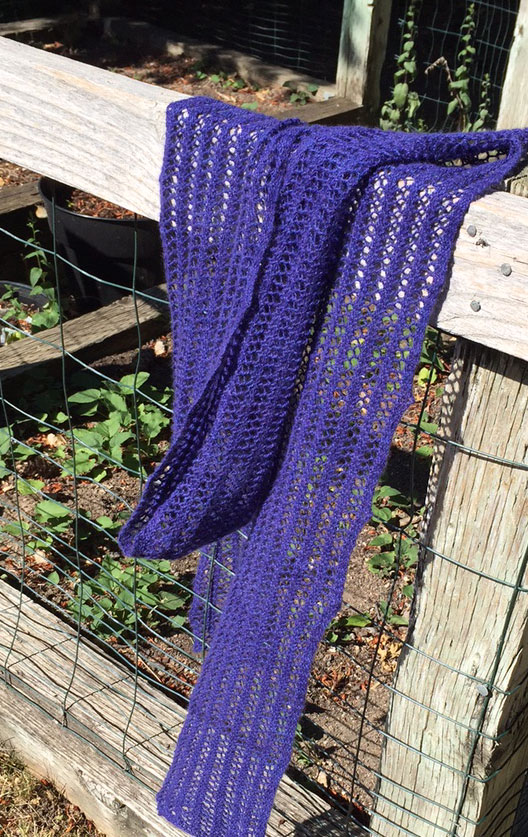
I finally finished a knitting project the other day.  I made it with cashmere (from my stash!), and the pattern was a simple ladder lace.   I had come across a beautiful picture of this scarf on pinterest, and the pattern was so simple that it was described in the comments of the pin:

Cast on 24 sts (or any number of stitches dividable with 4). Knit 2 rows Knit pattern row: K4, (YO, K2tog, K2) repeat between ( ) 5 times. Repeat the pattern row until your scarf is at desired length. Knit 1 row.

ladderlace1

This is a very easy pattern to follow and fun to knit.  Scarves are not typically my favorite thing to knit because they seem to go on and on and on and on, but this one was not too bad.  For one thing, I was knitting with cashmere, and that’s always a treat.  It was also a pattern I could work on while I was watching tv.  Perfect as we watched the last season of our favorite show Justified.

I’d like to knit it again with a larger needle size and then block it out even more loosely.  That’s how I first saw it on pinterest, and I loved the even lighter delicate quality it had.

I look forward to wearing this scarf though!


Newbery Medal 1928: Gay-Neck

The Newbery winner for 1928 was Gay-Neck, The Story of a Pigeon by Dhan Gopal Mukerji .  This was a beautifully written book about a boy and his pigeon.  I very much liked the relationship between the boy and the bird, but much of the book consists of Gay-Neck flying off, getting into trouble, and then narrowly escaping his prey.   I got a little tired of this repetition.  Gay-Neck perhaps grows weary of it too because he asks:  “Tell me this.  Why is there so much killing and inflicting of pain by birds and beasts on one another?  I don’t think all of you men hurt each other.  Do you?  But birds and beasts do.  All that makes me so sad.”

But Gay-Neck is brave, and he is a treasured member of the boy’s family.  Later he serves as a messenger pigeon in the war.  His service, which included a serious injury, results in him suffering from post traumatic stress disorder:

“Every time I hopped up in the air, my ears, I know not how were filled with terrible noises of guns, and my eyes saw nothing but flaming bullets.  I was so frightened that I would dash immediately to the ground.  You may say that I was hearing imaginary guns and seeing imaginary walls of bullets: maybe, but their effect on me was the same as that of real ones.  My wings were paralysed, my entrails frozen with terror”.

He is so damaged from the effects of war that he refuses to fly.  The boy tries to help him want to fly again, and this leads to Gay-Neck spending  time with a wise lama. I like the meditation that the lama shares with Gay-Neck.  He takes Gay-Neck into his hands and says:

“May the north wind bring healing unto you, May the south wind bring healing unto you, May the winds of the east and west pour healing into you.  Fear flee from you, Hate flees from you, And suspicion flees from you.  Courage like a rushing tide gallops through you; Peace possesses your entire being, And serenity and strength have become your two wings.  In your eyes shine courage; Power and prowess dwell in your heart!

You are healed, You are healed,  You are healed!   Peace,    peace,   peace.”

This was certainly not a book that I would have delved into on my own.  I will say this again and again I am sure, but this is the beauty of a reading “quest” like this.  I read somewhere that author’s message throughout the book was that man and beast are brothers, and I can definitely agree with that.  It was an exposure to another culture which I always think is a positive.

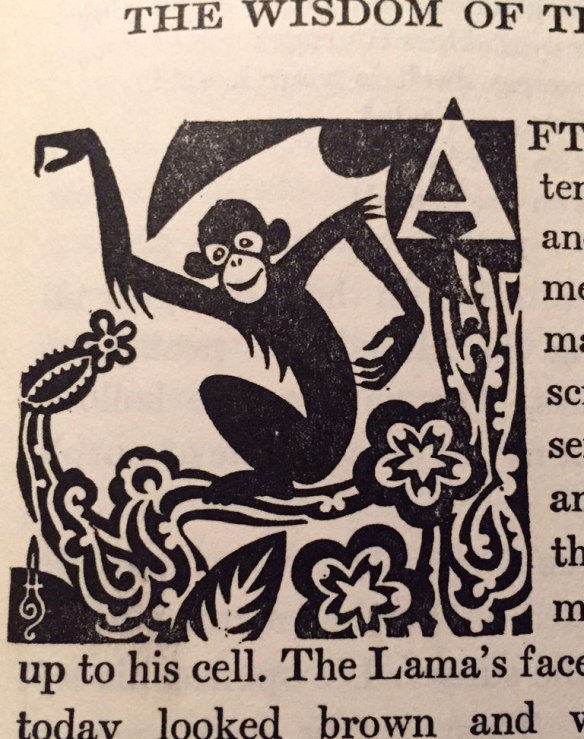
And, I always like seeing the different types of illustrations in each book that I read.

monkey


Newbery Books 1927: This Book Is An Example Of Why I Don’t Read Books About Animals

The Newbery Medal in 1927 was awarded to Smoky the Cow Horse by Will James, and it is a prime example as to why I almost never read books about animals.  The story begins with the birth of Smoky the horse.  At first he has a great life with his Mammy.  There is a very detailed account of his adventures as a young colt wandering the terrain with his mama keeping a close watch on him. He encounters a wolf and a mountain lion and  quickly learns that they are not his friends – throughout the story he will find that he has few friends.  His mostly peaceful way of life soon comes to end when he first meets humans who have come to brand him.  Humans, with one exception, do not prove to be a friend to Smoky either.

I found this book in its rather excruciating detail to be kind of boring, and when it wasn’t boring me, it was breaking my heart.  Smoky has this great life at first with his mom.  He roams free; it’s a good life for a young horse.  Then come the humans, and he is broken by a man named Clint.  This actually works out for awhile because Clint loves Smoky and they develop a great relationship.  Of course happiness for Smoky can’t possibly last, so Smoky is kidnapped by horse thieves and after that his life is pretty much crappy.  He is overworked, abused, and because he is stubborn and not a fan of humans, he ends up working as an “outlaw rodeo star” where he bucks off everyone that tries to stay on him.  By the end of the book, he is an old horse who is pretty much broken in both body and spirit. Miraculously, he is found by Clint (who has never forgotten him), and over time he begins to heal.

There is beautiful language and an appreciation for the Western culture that really comes through, but I just didn’t really like this book.  I say the language is beautiful, but it is written in a Western dialect that I am just not sure I like.  For example, mighty is a frequent descriptive word as in that was “mighty good” or the horse was “mighty strong”.  There is a lot of “figgering”.  Verb usage includes phrases like “he knowed this” or “he seen that”.  “Critters” abound throughout the book. There is something poetic though in the way James writes, and perhaps some readers would find his language suitable and endearing.

For me personally, I don’t know why anyone would want to read a book filled with such difficulty and sadness for a poor defenseless animal. I am anticipating Ole Yeller somewhere up the Newbery reading pipeline, and I am already trying to figure out a game plan for reading that.  My old game plan, which had worked for 48 years, was to avoid that book like the plague.  But now – it awaits.


Newbery Books 1926: Shen of the Sea and The Voyagers

The Newbery winners of 1925 and 1926 have been books of folk tales, fairy tales, and tales of adventure.

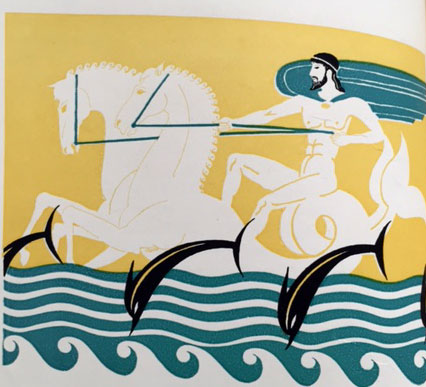
The 1926 Newbery Honor was a book called The Voyagers by Padraic Colum. It is about the early exploration of the Atlantic Ocean leading up to the discovery of the Americas. One of the cool things about reading this book is that it was an edition of the book actually published in 1925.  The pages are thick and sturdy and made with rag paper.  I also loved the illustrations.  Most of them are black and white, but there were a few color illustrations included.  Here’s an example: voyagersI really enjoyed some of these adventure and exploration stories, but then I became bored with others because they started to feel more like a recitation of history rather than an engaging story.  I did really like the story about the city of Atlantis.  It was in this book also that I learned that the word anchorite means religiouse recluse.  I don’t think I’d ever seen that word before.  Overall, it was ok.  I really like the “1926 reading experience” but the book was not anything that I found to be that memorable.

The Newbery Medal winner was also a compilation of stories.  It is called Shen of the Sea: Chinese Stories for Children by Arthur Bowie Chrisman.  The thing is – Chrisman is an American who never visited China, and he made up all of these “folk tales”.  They are written “in the style of Chinese folk tales”.  I just don’t know quite what to think about it.  Some of the stories are really funny.  Some of them are quite engaging.  It’s just odd to me that the Newbery Medal would be awarded to a book of “faux-Chinese folk tales”.  It’s been food for thought for sure.  I think I don’t like the idea of it, but why?  Well, if I hadn’t done any research and in 1926 there would have been no quick “google search”, I would have read this to my 1926 version of Davey and presented it to him as Chinese folk stories.  It would have just won the Newbery Medal and I’d think “well this must be a great book of Chinese stories!  We will learn something”.  Most of them are really fun to read though – I just am not sure I would have chosen this book for “the most distinguished contribution to American Children’s literature”.

There are some fun illustrations in this book too.

shen2I often am enjoying the illustrations as much (and more in some of these books) then the story.

shen1

I will remember Shen of the Sea – the whole idea of a book of “faux Chinese folk tales” was just too unusual to me to forget.

Now on to Smoky the Cowhorse – the 1927 Medal winner!